Research
I’m a cognitive neuroscientist who studies attention and working memory. My central area of investigation is how our sensory input constrains and shapes higher-level cognition. A second line of work tests the role of predictability and expectation.
As co-director of CMU’s Laboratory in Multisensory Neuroscience, I work on a wide variety of research questions and methodological approaches. Our skills span from basic psychophysics to complex neuroimaging work.
Below are recent posters from our group, as well as brief descriptions of my current research areas. Publications are listed under Publications
Recent LiMN posters
Images link to full pdf; will open in new tab.
Cortical networks for visual and auditory short-term memory
Prototypical visual- (blue) and auditory-biased (orange) regions overlain on tactile-biased regions (Tobyne et al., 2025).
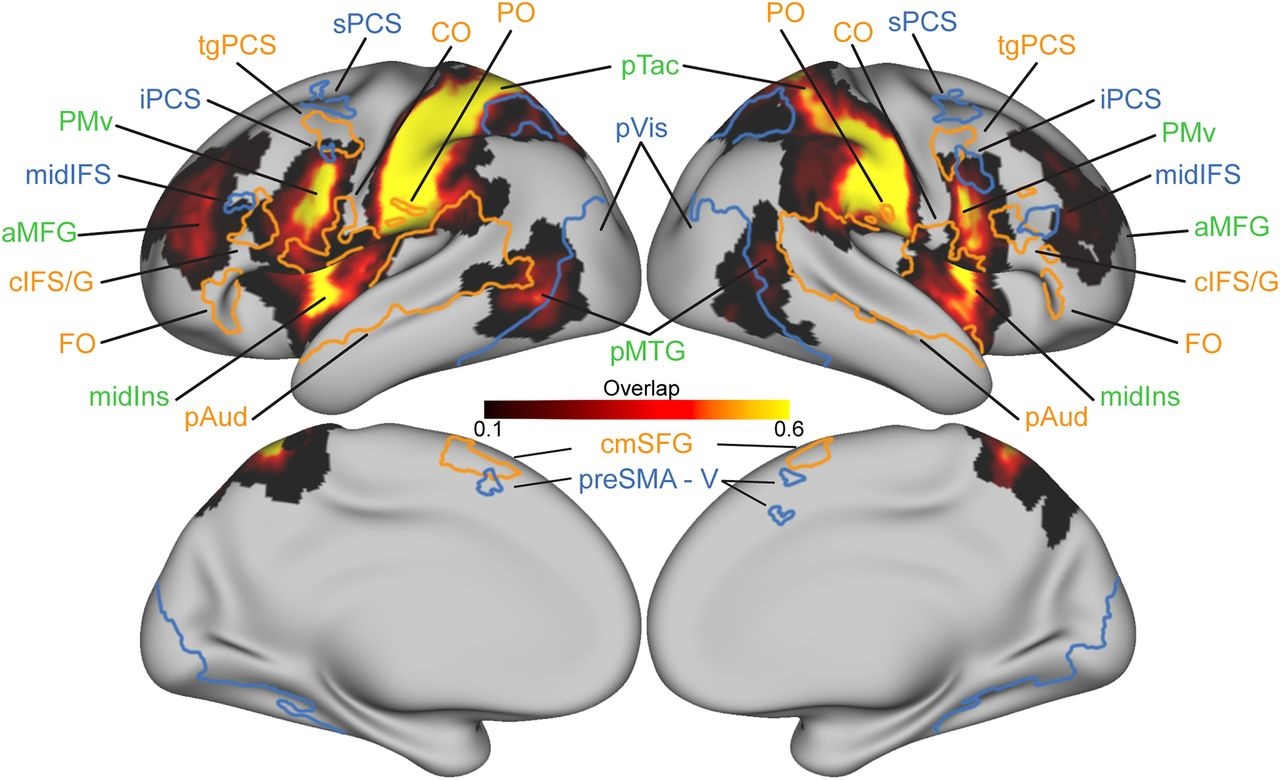
I established a robust, reliable method of using fMRI to map sensory-biased cortical networks, using auditory and visual working memory activation in individual subjects. I have characterized these networks’ organization, behavior, and connectivity, showing that discrete sub-regions of prefrontal cortex carry strong preferences for specific sensory modalities. Auditory-biased networks are slightly left-lateralized and extremely selective for auditory cognition; visual-biased networks are slightly right-lateralized and more general in their activation. More recent work has extended this map throughout frontal cortex and into posterior parietal cortex, has shown that an individual’s resting-state connectivity patterns can be used to predict where their sensory-biased regions will appear, and — by combining auditory, tactile, and visual working memory in the same participants — has revealed both modality-biased and supramodal working memory regions in human frontal cortex.
-
Tobyne, S. M., Brissenden, J. A., Noyce, A. L., & Somers, D. C. (2025). Combined auditory, tactile, and visual fMRI reveals sensory-biased and supramodal working memory regions in human frontal cortex. Journal of Neuroscience, 45(38), 1–18.

-
Noyce, A. L., Lefco, R., Tobyne, S. M., Brissenden, J. A., Shinn-Cunningham, B. G., & Somers, D. C. (2022). Extended frontal networks for visual and auditory working memory. Cerebral Cortex, 32(4), 855–869.
-
Lefco, R. W., Brissenden, J. A., Noyce, A. L., Tobyne, S. M., & Somers, D. C. (2020). Gradients of functional organization in posterior parietal cortex revealed by visual attention, visual short-term memory, and intrinsic functional connectivity. NeuroImage, 219, 117029.
Distinguishing auditory attention states
Auditory brainstem responses elicited by attended (green) and ignored (black) stimuli are indistinguishable (Figarola et al., 2026).
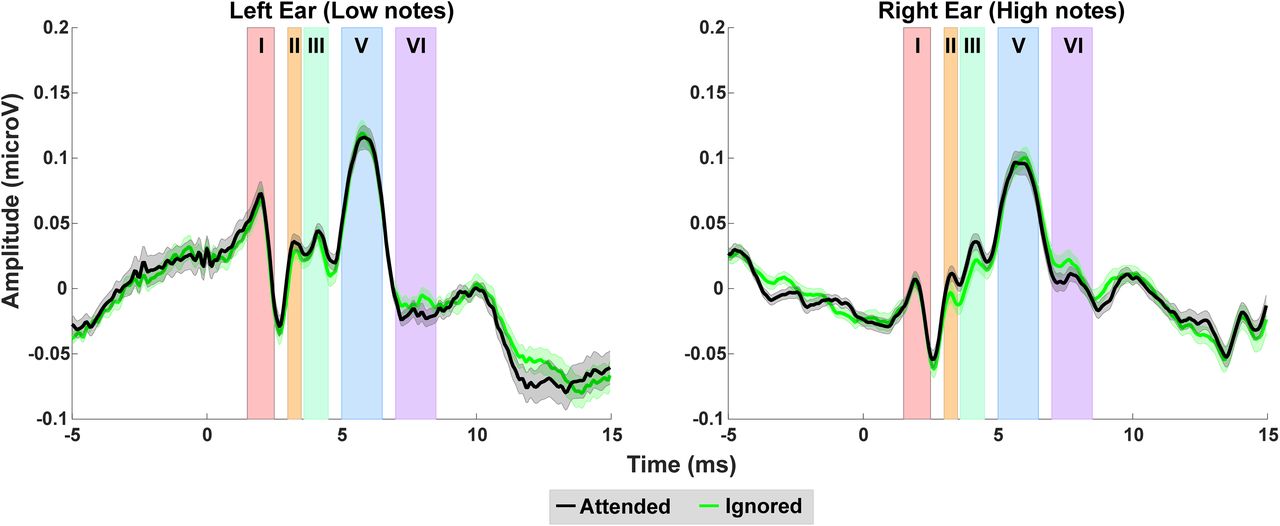
Using fMRI and EEG in conjunction with representational analysis techniques, I have shown when and where in the brain auditory attention is represented. While many aspects of attention are similar regardless of what is being attended to, the underlying brain states carry critical information about the cue or feature that is being used. Our results have demonstrated that the target of auditory attention is briefly represented in evoked neural responses but sustained in oscillatory activity, and we have identified key regions in sensory, parietal, and prefrontal cortex that encode attentional state. We have also pinned down the level of the auditory hierarchy at which top-down attention takes hold: attending to pseudo-tone melodies enhances cortical responses but leaves brainstem responses unchanged, placing this attentional gain at cortical rather than subcortical stages. This program of work has informed a broader theoretical framework for defining attention from an auditory perspective, and has surfaced individual differences in how strongly top-down attention modulates auditory-evoked responses — for example, between neurotypical and ADHD young adults.
-
Figarola, V., Li, Y., Tierney, A. T., Dick, F., Noyce, A., Maddox, R. K., & Shinn-Cunningham, B. G. (2026). Attention to psuedo-tone melodies enhances cortical but not brainstem responses in humans. Journal of Neuroscience, e1754252026.
-
Noyce, A. L., Kwasa, J. A. C., & Shinn-Cunningham, B. G. (2023). Defining attention from an auditory perspective. WIREs Cognitive Science, 14(1), e1610.
-
Kwasa, J. A. C., Noyce, A. L., Torres, L. M., Richardson, B., & Shinn-Cunningham, B. G. (2023). Top-down attention modulates auditory-evoked neural responses more strongly in neurotypical than ADHD young adults. Brain Research, 1798, 148144.
Perceptual organization in working memory
Listeners are significantly better at recognizing individual everyday sounds (orange), but much better at recognizing sequences of tones (blue, Noyce et al. 2024).
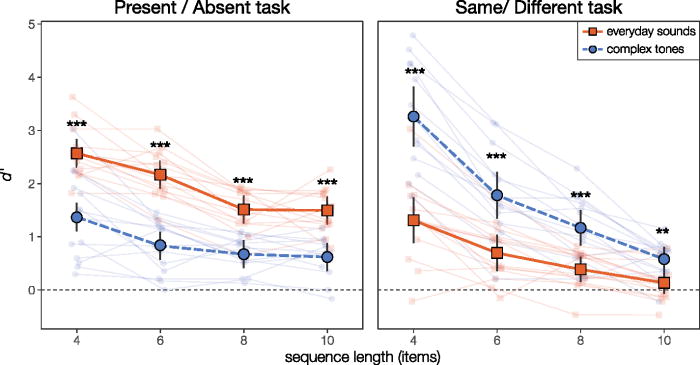
By exploring the relationships among perceptual organization, inter-stimulus similarity, and working memory task demands, I have shown that how listeners group sound objects into memory items critically impacts their accessibility at retrieval. This work builds on my doctoral exploration of the learning processes by which arbitrary visuospatial trajectories become familiar paths.
-
Noyce, A. L., Varghese, L., Mathias, S. R., & Shinn-Cunningham, B. G. (2024). Perceptual organization and task demands jointly shape auditory working memory capacity. JASA Express Letters, 4(3), 034402.
-
Maryott, J., Noyce, A., & Sekuler, R. (2011). Eye movements and imitation learning: Intentional disruption of expectation. Journal of Vision, 11(1:7), 1–16.
Information domains associated with sensory modality.
Vision’s innate affinity for spatial information and audition’s innate affinity for temporal information affect people’s ability to encode information into working memory. Further, spatial attention and working memory activate brain activity characteristic of visual processing regardless of sensory modality. Using carefully matched visual and auditory tasks, I have shown that when task demands require auditory spatial processing or visual temporal processing, people recruit cognitive machinery usually associated with the “other” sensory modality. More recent work has extended this picture to dual-task contexts, showing that interference between perception and working memory depends jointly on sensory modality and information domain.
Prediction and familiarity of distractors in attention
Most studies of attention have disregarded the non-target distractors; my work explores how the predictability and properties of distractors shape focused attention. Across flanker-task and related paradigms, we have tested the probability of various distractor configurations as well as the role of predictable timing, and we consistently find that predictable distractors are easier to ignore, supporting better attention performance. EEG markers of these processes — including dissociable P3 components elicited by violations of newly-learned predictions — point to a flexible, online updating of distractor expectations, and recent flanker-task work shows that these adjustments occur both anticipatorily and on the fly. In the auditory domain, we have characterized which features of an interrupting sound make it more disruptive to the listener’s ongoing task, and have shown that task-irrelevant properties of an interrupting talker — their identity and their continuity across the interruption — shape spatial selective attention even when the listener has no reason to attend to them.